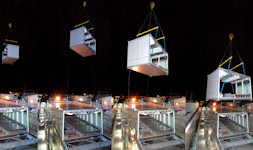
BuildOffsite Delegation Answers the Call
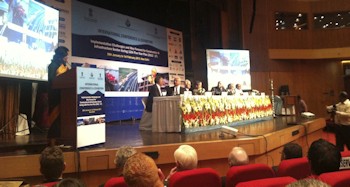
B uildOffsite (www.buildoffsite.com), the leading global organization of allied professionals for modern methods of construction, was recently asked to visit India on a knowledge sharing expedition. The reason for the trip was to meet with academic, industry and government leaders to assist in finding solutions to the challenge of housing the world’s second largest and fast growing population.
James B. Guthrie, AIA, President of Miletus Group, Inc. was asked to join the small and prestigious problem solving delegation which also included allied professionals from India, New Zealand and Great Britain.
Pressure is Building
 India is challenged by both the current size of its population, now over 1.2 billon, and its substantial projected population growth. 65% of India’s population is under 35 years old. While China is currently the largest country in terms of population, India is a close second and growing at a faster pace than China. Projections indicate that India’s population will surpass China by 2030. In addition to the overall growth of the population, the country is also rapidly changing from rural to urban based. While India is already the densest country in the world, currently only 31% of the population live in urban areas. As this shift continues there will be greater and greater pressure on building and supporting infrastructure in urban areas. Massive amounts of green field sites are being consumed to accommodate expanding urban lands.
Current estimates indicate that India has an existing housing shortage of over 18 million dwelling units at every income level. With the upcoming population growth and urban migration, this number is expected to become even more staggering over the coming years. India is in the midst of a very real housing and building crisis of unimaginable proportions and stands in a unique place in the world.
Population and Growth Rates 2012 – Three Largest Countries
| Country |
Population |
Growth Rate |
Annual Growth |
| USA |
313,847,465 |
0.9% |
2,900,000 |
| India |
1,205,073,612 |
1.3% |
15,700,000 |
| China |
1,343,239,923 |
0.5% |
6,700,000 |
What this all means is that India needs a lot of new buildings and they need them quickly. Along with homes, other buildings like schools, hospitals, police stations, and stores are also needed to support the growing population. This huge demand has been creating substantial pressure on the existing construction supply chain, which still uses fairly traditional building methods. As a result, there is simply not enough skilled labor or production facilities to keep up with the demand.
BuildOffsite Called to Help
Fortunately, India’s leaders understand the dilemma and are seeking solutions to it. Thanks to forward thinkers and organizations like BuildOffsite, word has been spreading around the world that offsite methods of construction can deliver buildings more efficiently and of greater quality than traditional building methods. India sees prefabrication as a major way forward in their construction industry. Miletus Group was there to join in the solution based conversations and to promote the idea of not just fast building, but quality building including achieving social, architectural and sustainability goals.
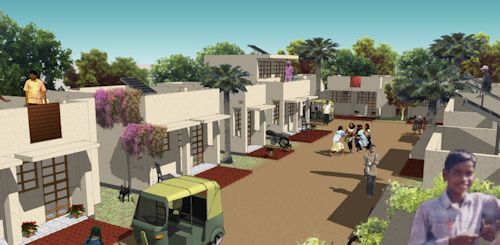
 While rapid population growth can tend to focus discussions on expediency, cost and logistics, this can spell social disaster if cultural history and social norms are forgotten in the process. India, especially, has a long and impressive cultural tradition of building magnificent buildings, most notably displayed in the elegant Taj Mahal. Over 350 years old, the Taj Mahal is as beautiful now as the day it was completed. This is due to the obsession with quality that its builders had, and is a good lesson that should not be forgotten in today’s climate of need. Architecture feeds the soul of a nation and provides future inspiration through generations of thoughtful predecessors. Factory made ‘ticky-tacky little boxes’ may provide a temporary fix, but good design, no matter how humble, will add permanency and pride to an enduring built environment. Architects must be a part of the solution and the transformation from traditional to modern methods of construction.
The Future is Now
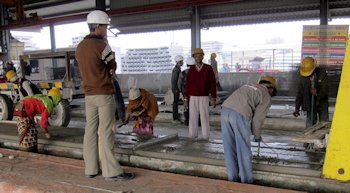 India is a place of action. Changes to the building industry are occurring right now. Prefabricated techniques are being used in the way of precast concrete buildings. The systems are however, still a bit rough and rely on traditional onsite skills used in an offsite location. Coming soon, though are more modern offsite factories and methods that use lighter and faster framing and more sustainable building practices.
The positive energy expressed by the Indian hosts of the BuildOffsite delegation was palatable. They are ready to implement big ideas at big scales. It is not too big a stretch to imagine India, in just a few years, as the world leader in offsite construction. Miletus Group is proud and excited to have been a part of these early talks. We also look forward to being a part of the growth that is India’s present and future life.
* Demographic information from various governmental websites.


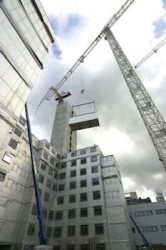
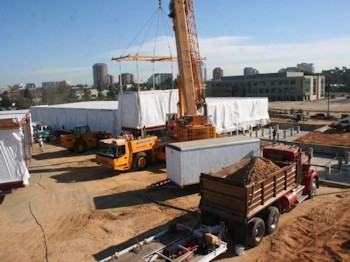 When a San Diego medical group wanted to expand their radiation oncology center, they sought speed and quality. To meet these goals they choose prefabrication.